Saturday, January 27, 2007

Chapters 6-7: Prior starts to talk

A patient being loaded onto a hospital train at a Casualty Clearing Station, for transport to a larger Stationary or General Hospital farther back the Somme, October 1916. Casualty Clearing Stations were usually located next to railway lines to allow patients to be evacuated by train.

Prior starts to talk (a bit)

Prior's ability to speak comes back, but he still finds it almost impossible to 'open up' in his sessions with his psychiatrist, Rivers. He is suspicious of Rivers, and resents the impersonal nature of the sessions, referring to talking to Rivers being like talking to 'empathic wallpaper'. He wants Rivers to open up too, so that they can interact as human beings; he also wants to undergo hypnosis, to unearth and discover the horrid memories which are causing him such unbearable nightmares every night - but Rivers believes that, if Prior will only admit it, he knows what those memories are already.

Empathy, sympathy and cruelty

We are also introduced to some of the other characters with influence over the lives of Prior and the other patients. Firstly, we meet Prior's father, a tough, bully of a man, who is embarrassed by the emotional wreck his son appears to have become; and Prior's mother, who is just as embarrassed by her husband! And we sit in on a meeting of the psychiatrists, when Brock, Bryce, Ruggles and Rivers chat about their different cases, but, especially, about Sassoon. Rivers sees it as his duty to get Sassoon back to the front - but the others question whether or not this is actually the right thing to do.

Some things to think about:
  1. Why is Prior so reluctant to open up to Rivers and confide in him?
  2. Why is Prior's father so ashamed of his son?
  3. Why do you think Rivers sees it as so important to get Sassoon 'fit' for battle again?
* * * * * *
Some quotations:

The lack of sympathy in people like Prior's father in response to the psychological damage of warfare:
  • He's get a damn sight more sympathy from me if he had a bullet up his arse...
The naive and romantic view of war shared by many people on the home front or in power:
  • ...they really do believe the whole thing's going to end in one big glorious cavalry charge... [This is in reference to the 19th Century poem, 'The Charge of the Light Brigade', to which Prior cynically refers in this chapter himself.]
We see two different views on the 'camaraderie' of soldiers on the front. Firstly, Prior, in his extreme misanthropy, hates it all:
  • The men are pack animals.
Whereas Sassoon quietly admits his own homosexuality, a sign of the warmth which grows between men in such circumstances:
  • Probably just as well. My intimate details disqualify me for military service.
And lastly, we learn more about the indifference of the folks back home to the horrors being played out on the Western Front:
  • He wasn't even old enough to enlist. And nobody gives a damn.
  • ...it doesn't even put them off their sausages! Have you ever sat in a club room and watched people read the casualty list?
And what does 'protopathic' mean?
Feeling or sensing pain that has no specific cause (i.e. emotional, psychological); primitive; primary...
The psychiatrists are debating how seriously to take EMOTIONAL wounds as opposed to PHYSICAL wounds. Their very profession demands that they take them with the utmost seriousness, but the pressure from the government and the army is to 'cure' soldiers of such weaknesses as soon as they possibly can...

Saturday, January 20, 2007

Chapters 4-5: Four Damaged Men

An Army surgeon operating on a wounder soldier in the trenches

Anderson

Anderson, another patient, confides in Rivers about a recurrent nightmare where he is tied up with ladies' corsets, locked in a coffin, and then encounters Rivers dressed in his post-mortem apron - a nightmare from which Anderson always wakes up vomiting. Anderson was a medical doctor before he came to Craiglockhart, and he is haunted by his memories of the war, including one where a dying man simply wouldn't stop bleeding. But now he is afraid that he is becoming less of a man because of what has happened to him.

Burns

We also follow Burns on a trip out of Craiglockhart. (Hardly any of the patients are kept there against their will.) Burns takes a bus into the countryside, and runs through the fields until he finds a tree which is being used by hunters to hang and dry out dead animals. He is drawn to this tree, as he is drawn to the idea of death, and strips naked to lie on the ground in the middle of the animal corpses. However, he is still drawn, irresistibly, back to the comfort of the hospital at the end of the day.

Prior

Prior is a particularly angry and difficult patient, who, for whatever reason, is not able (or willing) to communicate through speech. So, instead, he uses paper and pen to utter his short outbursts. He reveals very little about what he is feeling, and appears very hostile to everyone else. BUT we are given a clue as to the torment beneath his antisocial behaviour when we find out that his nightmares are SO disturbing that they are trying to find a way for him NOT to have to share a room with anyone else.

Rivers

Finally, we learn of Rivers' experience as a younger doctor, experimenting with the boundaries of pain alongside a fellow doctor/medical student, Henry Head. Rivers, too, like the patients, is not immune to nightmares - and the one he describes harks back to experiments he and Head undertook on each other, cutting open nerve endings on their own bodies, applying pain and other stimuli, and then studying the nerves' own process of REGENERATION (i.e. healing). He is troubled by the fact that, in trying to 'heal' his own patients, he ends up pushing them to new levels of emotional pain beforehand.

Some things to think about:
  1. Lots of the men seemed to be concerned about the idea of 'emasculation' (i.e. having their maleness taken away by the war). Why do you think this is? And what evidence are we given of this?
  2. What are your first impressions of Prior? He is to become very important in the book as a whole, and so his first appearance is even more crucial.
  3. Why do you think Rivers is SO troubled by his own nightmare? What does it show us about how he is feeling?
  4. How do you account for Burns' trip into the countryside? Why do you think he behaves in this way?
* * * * *

Some quotations:

Ghosts and Nightmares - the mind keeps taking them back:
  • A branch rattled along the windows with a sound like machine-gun fire, and he had to bite his lips to stop himself crying out.
  • Every step was a separate effort, hauling his mud-clogged boots out of the sucking earth. His mind was incapable of making comparisons, but his aching thighs remembered, and he listened for the whine of shells.
  • And for a second he was back there, Armageddon, Golgotha, there were no words, a place of desolation so complete no imagination could have invented it.
Death - they have come so close that it is all they can think about:
  • ...there was nothing I could do. I just stood there and watched him bleed to death.
  • When all the corpses were on the ground, he arranged them in a circle round the tree and sat down within it, his back against the trunk. He felt the roughness of the bark against his knobbly spine. He pressed his hands between his knees and looked around the circle of his companions.
  • This was the right place. This was where he had wanted to be.
Misanthropy - especially towards those who have never fought:
  • Nobody else in this stinking country seems to find it difficult.
  • He threaded his way through the crowds on Princes Street. Now that Robert was gone, he hated everybody, giggling girls, portly middle-aged men, women whose eyes settled on his wound stripe like flies. Only the young soldier home on leave, staggering out of a pub, dazed and vacant-eyed, escaped his disgust.
Emasculation - the effect of war seems to steal from them their 'maleness':
  • A pair of lady's corsets. They fastened them round my arms and tied the laces. [Anderson's nightmare]
  • If this is leading up to a joke about ladies' choirs, forget it. I've heard them all.
  • The boy - he couldn't have been more than nineteen - had a neat little hole too. Only his was between his legs.
  • The change he demanded of them - and by implication of himself - was not trivial. Fear, tenderness - these emotions were so despised that they could be admitted into consciousness only at the cost of redefining what it meant to be a man.
Camaraderie - the army provides a sense of belonging:
  • I think the army's probably the only place I've ever really belonged.
  • Now, waking up to find Rivers sitting by his bed, unaware of being observed, tired and patient, he realized he'd come back for this.
The reality of war - as Rivers is trying to present it to his patients:
  • ...that breakdown was nothing to be ashamed of, that horror and fear were inevitable responses to the trauma of war and were better acknowledged than suppressed, that feelings of tenderness for other men were natural and right, that tears were an acceptable and helpful part of grieving...

Saturday, January 13, 2007

Chapters 1-3: Arriving at Craiglockhart

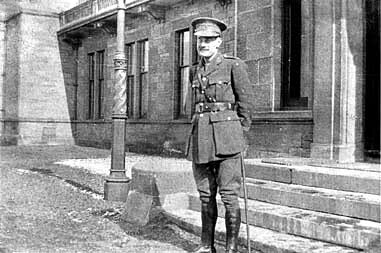
This is an original photograph of the actual Rivers in front of the actual Craiglockhart hospital

Sassoon is introduced


In these chapters, Sassoon arrives at Craiglockhart hospital, where he meets his psychiatrist, Rivers. We learn how he ended up as a patient here: he had written a letter against the war and thrown his medal into the river, and so the government had to do something about him. A friend of his, Robert Graves, persuaded them to admit him into a psychiatric hospital rather than imprison him - although the book makes it clear that he is perfectly sane.

The other inpatients

We see Sassoon's delicate mental state, and learn about his nightmares and hallucinations; and we also encounter some of the other inpatients, including Burns - who vomits whenever he eats, because it reminds him of when a bomb sent him through the air to land, head first, in the exploded intestines of another soldier. Criaglockhart hospital clearly contains lots of living examples of the damage the war has done.

Sassoon's poetry

We also read a few of Sassoon's own poems, which he sends to Rivers as evidence of how he feels and why he has behaved the way he has. This will happen throughout the novel, and Barker allows us to study the character of Sassoon just as much through his poetry as through her own narrative.

Some things to think about:
  1. Why do you think Sassoon decided to write the letter and throw away his medal?
  2. What do you think Rivers thinks of Sassoon, and how has this changed since he actually met him?
  3. What was your response to the other inpatients, especially Burns?

* * * * * * * *

For those of you who want to study the novel in more depth (especially those of you doing your GCSE this year), here are some of the important quotations from these chapters, organised under different thematic headings:

Ghosts and Nightmares

Immediately, he saw lines of men with grey muttering faces clambering up the ladders to face the guns. He blinked them away.

'You can't put people in lunatic asylums just like that. You have to have reasons.'
'They've got reasons.'
'Yes, the Declaration. Well, that doesn't prove me insane.'
'And the hallucinations? The corpses in Piccadilly?'

'It was just that when I woke up, the nightmares didn't always stop. So I used to see...' A deep breath. 'Corpses. Men with half their faces shot off, crawling across the floor.'

'When I woke up, the pavement was covered in corpses. Old ones, new ones, black, green.' His mouth twisted. 'People were treading on their faces.'

Pipes lined the walls, twisting with the turning of the stair, gurgling from time to time like lengths of human intestine.

Nightly, he relived the experience, and from every nightmare he awoke vomiting. Burns on his knees, as Rivers had often seen him, retching up the last ounce of bile, hardly looked like a human being at all. His body seemed to have become merely the skin-and-bone casing for a tormented alimentary canal. His suffering was without purpose or dignity...

Reminiscing about life before the war

He shifted in his seat and sighed, looking out over fields of wheat bending to the wind. He remembered the silvery sound of shaken wheat, the shimmer of light on the stalks.

How Sassoon got his nickname, 'Mad Jack'

'...In the end I didn't know whether I was trying to kill them or just giving them plenty of opportunities to kill me.'

Sassoon's misanthropy and hatred of civilians and people who haven't seen the war first-hand

His voice became a vicious parody of an old man's voice. '"Lost heavily in that last scrap." You don't talk like that if you've watched them die.'

'...The point is you hate civilians, don't you? The "callous", the "complacent", the "unimaginative".'

'You must've been in agony when you did that.'
Sassoon lowered his hand. 'No-o. Agony's lying in a shell-hole with your legs shot off. I was upset.'

Seeing death up close

He remembered...passing the same corpses time after time, until their twisted and blackened shapes began to seem like old friends.


Monday, January 01, 2007

NEW TEXT: Regeneration


This term, we will be reading REGENERATION by Pat Barker. Although this is part of a trilogy of novels about the First World War (The Regeneration Trilogy), we will only be reading the first one as part of the Book Group. Not only is it a pretty extraordinary book, but it will also give invaluable context to your GCSE study of First World War poetry.

A Summary

Regeneration is the fictionalization of Siegfried Sassoon's stay in a mental hospital, Craiglockheart, in 1917 after he'd written a letter to Parliament protesting that the war was being needlessly extended. His psychiatrist, Rivers, is given the task of getting Sassoon to 'see sense and return to the front'. Rivers, a gentle, perceptive, humanitarian, attempts to save Sassoon and the other inmates from the demons that have come to haunt them. His burden is to share their grim experiences as they become able to articulate the horrors that have rendered them psychologically paralysed .

But how do you help people make sense of a world that has possibly gone mad itself? Whilst at Craiglockheart Sassoon meets a young man called Wilfred Owen and gives him valuable advice on his poem 'Anthem For Doomed Youth'. Meanwhile, the reader and Rivers become aquainted with a working class officer, a rarity in itself, named Prior who has lost his ability to speak, through shock or possibly even by choice.

Buying the Book

If you are to take part in the Book Group this term, you will need to get hold of a copy of the book. The quickest among you will get hold of a copy from your local library; the rest of you will need to purchase a copy. Although you can buy it from Waterstones in Walthamstow, this will not be the cheapest way to do so - and you may have to wait to order it from them anyway. The cheapest way to buy a copy is online, by following one of the following links:
N.B. I have purchased 20 copies of the novel, and they will be on sale from me - for £5 each - on a first come first served basis from Friday 5th January.

Reading Schedule

I will expect you to read approximately 20 pages (or two chapters) each week. This should be MUCH easier than last term, as the prose is much more modern and accessible. I suggest you choose a couple of evenings a week, and read a chapter on each one, every week.

You should read:

by Sunday 14th January: Chapters 1-3
by Sunday 21st January: Chapters 4-5
by Sunday 28th January: Chapters 6-7
by Sunday 4th February: Chapters 8-9
by Sunday 11th February: Chapters 10-11

HALF TERM: Catch-up

by Sunday 25th February: Chapters 12-13
by Sunday 4th March: Chapter 14
by Sunday 11th March: Chapters 15-16
by Sunday 18th March: Chapters 17-18
by Sunday 25th March: Chapters 19-21
by Sunday 1st April: Chapters 22-23

Any questions on any of this, just email me...

Mr Savage