THIS BLOG HAS BEEN PAUSED, PENDING ANALYSIS OF THE RECENT WEB 2.0 SURVEY RESULTS.
IT WILL HOPEFULLY BE RESUMED IN SEPTEMBER, AT WHICH POINT IT MAY EVEN BE OPERATED AS A FULL COURSE IN GCSE ENGLISH LITERATURE.
IN THE MEANTIME, YOU ARE WELCOME TO READ THE BOOK SCHEDULED FOR THIS TERM - DRACULA BY BRAM STOKER. HIGHLY RECOMMENDED!
ALL POSTS SO FAR ARE STILL ACTIVE, AND SO YOU CAN STILL USE THE BLOG TO HELP YOU WITH REGENERATION (AND YOU CAN STILL COMMENT TOO).
Saturday, April 21, 2007


Wednesday, April 04, 2007
Chapters 19-23: Different cures
 The two sequels to Regeneration, the second of which won the prestigious BOOKER PRIZE when it was published in 1995.
Goodbyes
Billy Prior's relationship with Sarah seems to be levelling out, and he is even due to meet her mother. Sassoon and Owen say their goodbyes to each other, and Rivers says his own goodbye to Craiglockhart. Towards the end of the novel, Sassoon passes his 'board' assessment, and is declared fit to go back and fight on the front line. Even Willard regains the use of his legs again, although this is not the 'miracle' he deems it to be.
Nightmares
Most significant in these final chapters, however, is Rivers' experiences in London, and, in particular, during his visit to the National Hospital in Queen's Square. Here, he spends the day with Dr Yealland, whose methods of curing a soldier's mutism are, at first sight, particularly brutal (imprisonment in a locked room whilst increasingly powerful electrical currents are placed on his mouth, neck and throat). But the nightmare Rivers has the following night make him wonder whether his own brand of 'healing' - his psychanalytic dialogue - is actually any different in the end, since that, too, attempts to cure the sick soldier and render them fit again for war.
The Trilogy Continues...
Finally, the novel does not really 'end', leaving itself wide open for the next two books in the trilogy, The Eye in the Door, and The Ghost Road. There is much more to find out about Dr Rivers, and his most damaged of patients, Billy Prior...
Some things to think about:
- What do you think is going through Sassoon's mind when he gets passed fit for active duty again?
- How did you respond when you read the scene in Yealland's hospital?
- How do you account for Rivers' nightmares about the horse's bit?
* * * *
As for the useful quotations this week, I thought it might be useful for YOU to categorise each of them. (You are probably familiar with the different themes and topics which have recurred so far.) So read through these, and see if you can work out why each of them is significant. You could even use the COMMENTS facility to work out your own P.E.E. for some of them...
As for the useful quotations this week, I thought it might be useful for YOU to categorise each of them. (You are probably familiar with the different themes and topics which have recurred so far.) So read through these, and see if you can work out why each of them is significant. You could even use the COMMENTS facility to work out your own P.E.E. for some of them...
- The darkness, the nervousness, the repeated unnecessary swallowing...He was back in France, waiting to go back out on patrol.
- He told himself he was never going back, he was free, but the word 'free' rang hollow. Hurry up, Sarah, he thought.
- He was glad to have the night shut out, with its memories of fear and worried sentries whispering.
- Without warning, Prior saw again the shovel, the sack, the scattered lime. The eyeball lay in the palm of his hand.
- He needed her ignorance to hide in. Yet, at the same time, he wanted to know and be known as deeply as possible. And the two desires were irreconcilable.
- And yet he was writing, and he seemed to think he was writing well. All the anger and grief went into the poetry. He had given up hope of influencing events. Or perhaps he'd just given up hope.
- Any explanation of war neurosis must account for the fact that this apparently intensely masculine life of war and danger and hardship produced in men the same disorders that women suffered from in peace.
- ...a creature - it hardly resembled a man - crawled through the door and began moving towards him...It seemed to Rivers that his expression was both sombre and malevolent.
- ...in a war nobody is a free agent. He and Yealland were both locked in, every bit as much as their patients were.
- I think he's made up his mind to get killed.
- Rivers felt there was a genuine and very deep desire for death.
- And if death were to be denied? Then he might well break down. A real breakdown, this time.
Sunday, March 18, 2007
Chapters 17-18: Ready to go back?
 A French trench at Verdun, 1916: this is the experience to which Prior and Sassoon would return, if they rejoined the war...
Yellow
Most of chapter 17 concerns Sarah Lumb, and her efforts to persuade her mother that she knows what she is doing with Billy Prior. Her mother has a view that hardly any men can be trusted, and that women need to know how to get all they can out of men - rather than the other way around. However, Sarah remains convinced that she is safe with Billy - so much so, in fact, that she turns down her mother's offer of a job in her tea room, in order to stay working at the munitions factory, stay 'yellow', and, therefore, stay close to Billy Prior.
Sassoon
Sassoon appears very unstable and 'on edge' in these chapters. It is almost time for the decision to be made - at the 'board' (or medical panel) - about whether or not he is fit to go back to fight in the war. Then he hears his friend, Graves, speaking with shame and prejudice about Sassoon's own homosexuality, which upsets him considerably: a friend of theirs is even being sent for psychiatric 'treatment', to 'cure' him of being gay! And, finally, when the board finally arrives, he gets impatient with being kept waiting in the waiting room - so much so that he even starts to consider whether he will continue his protest - and even take it to parliament...
Prior
Meanwhile, Prior has NOT been passed fit for battle, and is redeployed as a soldier on the 'Home Front' for the rest of the war. Many would be relieved - overjoyed, even - to have their life saved in this way. But Prior is too complex for that, and greets the news with tears, shame and ignominy...
Some things to think about:
- Why does Sarah's mother want her to stop working at the munitions factory and to be careful of Billy Prior?
- What upsets Sassoon so much about his conversation with Graves?
- Why does Sassoon 'bunk' the medical panel?
- Why isn't Prior happy at the news that he will not go back to the trenches?
* * * * * *
Some useful quotations:
Do you know, you never talk about the future any more? Yes, I know what you're going to say. How can you? Sass, we sat on a hill in France and we talked about the future. We made plans. The night before the Somme, we made plans. You couldn't do that now. A few shells, a few corpses, and you've lost heart. [The war takes everything away from the soldier - including, here, the future.]
...you've got this enormous emphasis on love between men - comradeship - and everybody approves. But at the same time there's always this little niggle of anxiety. Is it the right kind of love? Well, one of the ways you make sure it's the right kind of love is to make it crystal clear what the penalties for the other kind are. [This explains the 'double-standards' which existed towards male intimacy: i.e. it was OK to a point, but no further. Remember that, at this time, you could still be put in jail for being gay - and many men were.]
Like everybody else in the hospital, Sassoon's reflexes were conditioned by the facts of trench warfare. [Again, there is no escaping the ghosts of the war...]
Prior didn't answer. Rivers said gently, 'Everybody who survives feels guilty. Don't let it spoil everything.' [Just like in lots of the WW1 poems, so here it is made clear that 'surviving' the war is a complex experience, ridden with shame and guilt.]
Do you know, you never talk about the future any more? Yes, I know what you're going to say. How can you? Sass, we sat on a hill in France and we talked about the future. We made plans. The night before the Somme, we made plans. You couldn't do that now. A few shells, a few corpses, and you've lost heart. [The war takes everything away from the soldier - including, here, the future.]
...you've got this enormous emphasis on love between men - comradeship - and everybody approves. But at the same time there's always this little niggle of anxiety. Is it the right kind of love? Well, one of the ways you make sure it's the right kind of love is to make it crystal clear what the penalties for the other kind are. [This explains the 'double-standards' which existed towards male intimacy: i.e. it was OK to a point, but no further. Remember that, at this time, you could still be put in jail for being gay - and many men were.]
Like everybody else in the hospital, Sassoon's reflexes were conditioned by the facts of trench warfare. [Again, there is no escaping the ghosts of the war...]
Prior didn't answer. Rivers said gently, 'Everybody who survives feels guilty. Don't let it spoil everything.' [Just like in lots of the WW1 poems, so here it is made clear that 'surviving' the war is a complex experience, ridden with shame and guilt.]
Sunday, March 11, 2007
Chapters 15-16: Progression or Suppression?
 One of the many Martello towers on the barren and wild Suffolk coast, very much like the one visited by Burns and Rivers, and in which Burns hides the night of his unstoppable nightmares.
What strikes me about these two chapters is the question they raise about PROGRESS, in relation to soldiers suffering from the psychological fallout of the war. If progress requires the soldier to suppress (or, in other words, to ignore and bury, deep within themselves) the pain and distress of their remembered experience - then is this, in fact, progress at all?
Keeping Up Appearances
Burns has, it appears, made immense 'progress'. He has managed to leave Craiglockhart, and then, having returned to London briefly, leave there too - to return to his childhood origins on the Suffolk coast. There he lives a simple life, mixing with the locals, breathing the sea air and going for long walks in the countryside. When Rivers visits him, Burns manages to go most of each day without even mentioning the war at all, and gives the appearance that he has simply 'forgotten' about it.
Trying to Escape
However, the screams and nightmares every night, and his one, nighttime 'escape' to the terrifying, half-submerged Martello tower - these all provide solid evidence that he has forgotten nothing. He is simply trying to suppress the memories - and not very effectively at that. Also, it seems interesting that he is returning to 'childhood' to help him with this - which suggests this is not only suppression, but also regression, neither of which has anything to do with true progress.
Certain Death
Meanwhile, Sassoon's 'progress' takes the form of his decision to go back and rejoin the war. Or, in other words, to go and fight and risk likely death, for King and Country! In the eyes of the government, this would certainly be regarded as 'progress'; but, if it basically means he is putting himself in the hands of death, I fail to see how progressive that can really be felt to be...
Some things to think about:
- Why does Burns choose to go back to Suffolk to live?
- What is the significance of the Martello tower?
- Why has Sassoon decided to go back to fight?
- How do you think Rivers feels when he hears this news?
* * * * *
Some useful quotations:
He looked like a child trying to remember what it was that grown-ups said to newly arrived guests. He also looked, for the first time, deranged. [Note how the war has stripped him of all social skills, leaving him no more socially adept than a little child.]
Obviously, however hard Burns tried to thrust memories of the war behind him, the nightmare followed. [In other words, for Burns, any attempt at 'suppression' didn't really work.]
Rivers thought how misleading it was to say that the war had 'matured' these young men. It wasn't true of his patients, and it certainly wasn't true of Burns, in whom a prematurely aged man and a fossilised schoolboy seemed to exist side by side. It did give him a curiously ageless quality, but 'maturity' was hardly the word. [This is more evidence of "the complete disintegration of personality' effected by the war: the way in which, in one way, they were made old 'before their time', when contrasted with the way in which they were taken, psychogically and for comfort, back to their childhood persona, simply created an 'ageless' mess of a human being.]
Corpses were everywhere in the trenches. Used to strengthen parapets, to prop up sagging doorways, to fill in gaps in the duckboards. [This goes to show how commonplace death was in the trenches, and how it almost became a 'way of life', to which soldiers necessarily became desensitised.]
A resemblance that had merely nagged at him before returned to his mind with greater force. This waste of mud, these sump-holes reflecting a dim light at the sky, even that tower. It was like France. Like the battlefields. A resemblance greater by night than by day, perhaps, because here, by day, you could see things grow, and there nothing grew. [Another example of the ghosts of the war which haunt those who had contact with it, wherever they go - and even, here, in the quiet, Suffolk countryside, where the tower is described as "like the bones of a skull".]
His surrender, when it came, was almost shocking. Suddenly, his body had the rag-doll floppiness of the newborn. [Here, the REGRESSION is almost total...]
'I couldn't seem to get out of the dream. I woke up, I knew I was awake, I could move and yet... it was still there.' [See above: the nightmares never go away...]
He had missed his chance of being ordinary. [One inevitable consequence of the war was that those who fought in it, like Burns, would NEVER be the same again.]
And finally, if we need clarification of Sassoon's reasons for going back to fight, we need look no further than the poem he gives Rivers:
When I’m asleep, dreaming and drowsed and warm,
They come, the homeless ones, the noiseless dead.
While the dim charging breakers of the storm
Rumble and drone and bellow overhead,
Out of the gloom they gather about my bed.
They whisper to my heart; their thoughts are mine.
‘Why are you here with all your watches ended?
‘From Ypres to Frise we sought you in the line.’
In bitter safety I awake, unfriended;
And while the dawn begins with slashing rain
I think of the Battalion in the mud.
‘When are you going back to them again?
‘Are they not still your brothers through our blood?’
He looked like a child trying to remember what it was that grown-ups said to newly arrived guests. He also looked, for the first time, deranged. [Note how the war has stripped him of all social skills, leaving him no more socially adept than a little child.]
Obviously, however hard Burns tried to thrust memories of the war behind him, the nightmare followed. [In other words, for Burns, any attempt at 'suppression' didn't really work.]
Rivers thought how misleading it was to say that the war had 'matured' these young men. It wasn't true of his patients, and it certainly wasn't true of Burns, in whom a prematurely aged man and a fossilised schoolboy seemed to exist side by side. It did give him a curiously ageless quality, but 'maturity' was hardly the word. [This is more evidence of "the complete disintegration of personality' effected by the war: the way in which, in one way, they were made old 'before their time', when contrasted with the way in which they were taken, psychogically and for comfort, back to their childhood persona, simply created an 'ageless' mess of a human being.]
Corpses were everywhere in the trenches. Used to strengthen parapets, to prop up sagging doorways, to fill in gaps in the duckboards. [This goes to show how commonplace death was in the trenches, and how it almost became a 'way of life', to which soldiers necessarily became desensitised.]
A resemblance that had merely nagged at him before returned to his mind with greater force. This waste of mud, these sump-holes reflecting a dim light at the sky, even that tower. It was like France. Like the battlefields. A resemblance greater by night than by day, perhaps, because here, by day, you could see things grow, and there nothing grew. [Another example of the ghosts of the war which haunt those who had contact with it, wherever they go - and even, here, in the quiet, Suffolk countryside, where the tower is described as "like the bones of a skull".]
His surrender, when it came, was almost shocking. Suddenly, his body had the rag-doll floppiness of the newborn. [Here, the REGRESSION is almost total...]
'I couldn't seem to get out of the dream. I woke up, I knew I was awake, I could move and yet... it was still there.' [See above: the nightmares never go away...]
He had missed his chance of being ordinary. [One inevitable consequence of the war was that those who fought in it, like Burns, would NEVER be the same again.]
And finally, if we need clarification of Sassoon's reasons for going back to fight, we need look no further than the poem he gives Rivers:
When I’m asleep, dreaming and drowsed and warm,
They come, the homeless ones, the noiseless dead.
While the dim charging breakers of the storm
Rumble and drone and bellow overhead,
Out of the gloom they gather about my bed.
They whisper to my heart; their thoughts are mine.
‘Why are you here with all your watches ended?
‘From Ypres to Frise we sought you in the line.’
In bitter safety I awake, unfriended;
And while the dawn begins with slashing rain
I think of the Battalion in the mud.
‘When are you going back to them again?
‘Are they not still your brothers through our blood?’
Saturday, March 03, 2007
Chapter 14: No Escape
 It is worth bearing in mind that, alongside all the horror and pain of the REALITY of war, the government propaganda machine was continuously churning out posters and fliers trying to use guilt and emotional blackmail to PERSUADE the young men of Britain to sign up and fight. This poster was perhaps the most famous of all, featuring a very bullying pose by Kitchener, the Minister for War.
Sick Leave
In this chapter, we follow Rivers on his 'sick leave'. He spends some time with his sister and her husband, reminiscing about his own childhood, and, in particular, about his fractious relationship with his father. Next he goes to stay with Henry Head and his wife in London, and Head makes an offer to Rivers of a job in a war hospital in Hampstead - but Rivers doesn't know if he can drag himself away from Craiglockhart.
No Escape
The other episodes in this long chapter concern Prior - who is humiliated by a new doctor with whom he lacks the closeness he has with Rivers - and Sassoon - who is immensely excited by the final draft Owen has produced of the poem 'Anthem for Doomed Youth'. However, all of these episodes relate to the notion that one cannot escape the brutal reality of war: Rivers is supposedly on 'holiday', but the guns still keep him awake at night; Sarah discovers the room at the back of a hospital where all the disabled soldiers are 'stored', and wonders why society feels so ashamed of them; and Owen and Sassoon are only satisfied when their poetry admits the horror of war. There really is no escape...
Some things to think about:
- Why does Rivers not want to accept Head's offer of a job in London?
- Why did Rivers fall out with his father as a child?
- What shocks Sarah SO much about the room at the back of the hospital she visits?
- Why do you think Prior feels able to show warmth towards Sarah again?
* * * * * *
Some useful quotations:
... the two bloody bargains on which a civilization claims to be based. The bargain, Rivers thought, looking at Abraham and Isaac. The one on which all patriarchal societies are founded If you, who are young and strong, will obey me, who am old and weak, even to the extent of being prepared to sacrifice your life, then in the course of time you will peacefully inherit, and will be able to exact the same obedience from your sons. Only we're breaking the bargain, Rivers thought All over northern France, at this very moment, in trenches and dugouts and flooded shell-holes, the inheritors were dying, not one by one, while old men, and women of all ages, gathered together and sang hymns. [It might be worth comparing this to the poem in the Opening Lines GCSE anthology, Owen's 'Parable'. Both explore the hypocrisy and madness of sacrificing a whole generation for such tenuous goals.]
The congregation, having renounced reason, looked rather the happier for it and sat down to await the sermon. [Having seen what human beings can do to each other, and how horrid life can be, Rivers finds it impossible to keep a faith in some vague, mysterious 'god', because to do so would be to 'renounce reason'.]
...Genesis was no more than the creation myth of a Bronze Age people. [Like the previous quotation, Rivers lost his faith even as early as when he was a little boy.]
They would never come back, those times. [Before the war, it seems that all was happy, pure, safe. Now those happy days are gone forever. It might be worth reading an 1896 poem by Housman in this context.]
Now the same chicks were scruffy, bedraggled things running in the coops, and the only sound in the room was the roar of flame. [Just like the previous quotation, what once was innocent and beautiful, is now ruined and doomed. :(]
Faintly, over dark hedges and starlit fields, came the soft thud-thud of the guns. [There really is NO escape.]
She was still dazzled by the brightness of the light outside and the relative dimness of the interior, and so she had to blink several times before she saw them, a row of figures in wheelchairs, but figures that were no longer the size and shape of adult men. Trouser legs sewn short; empty sleeves pinned to jackets. One man had lost all his limbs, and his face was so drained, so pale, he seemed to have left his blood in France as well. [Compare this description with Owen's poem, 'Disabled'.]
They stared at her, but not as the men had stared on the other ward, smiling, trying to catch her eye. This was a totally blank stare. If it contained anything at all, it was fear. Fear of her looking at the empty trouser legs. Fear of her not looking at them. [Not only has war taken away much of their bodies, their youth, their hope, their life, but also their sexuality. They have, effectively, been desexualised, or even 'castrated' by the war. Here is a pretty girl, and they feel NOTHING.]
If the country demanded that price, then it should bloody well be prepared to look at the result. [Sarah, too, shares the anger of the likes of Prior and Sassoon about it all now.]
He thought he might buy himself...any little treat that might make him feel better. Less contaminated. [A little hint about another effect of the war on the soldier: it made them feel permanently dirty.]
I get this feeling that the...the crust of everything is starting to crack. [This hints at the complete destruction enacted on the whole world by the First World War, a world which would never be the same again. At A Level of university, you will probably read a poem called 'The Wasteland' by T.S.Eliot, which, written shortly after the end of the war, explores exactly the same idea.]
... the two bloody bargains on which a civilization claims to be based. The bargain, Rivers thought, looking at Abraham and Isaac. The one on which all patriarchal societies are founded If you, who are young and strong, will obey me, who am old and weak, even to the extent of being prepared to sacrifice your life, then in the course of time you will peacefully inherit, and will be able to exact the same obedience from your sons. Only we're breaking the bargain, Rivers thought All over northern France, at this very moment, in trenches and dugouts and flooded shell-holes, the inheritors were dying, not one by one, while old men, and women of all ages, gathered together and sang hymns. [It might be worth comparing this to the poem in the Opening Lines GCSE anthology, Owen's 'Parable'. Both explore the hypocrisy and madness of sacrificing a whole generation for such tenuous goals.]
The congregation, having renounced reason, looked rather the happier for it and sat down to await the sermon. [Having seen what human beings can do to each other, and how horrid life can be, Rivers finds it impossible to keep a faith in some vague, mysterious 'god', because to do so would be to 'renounce reason'.]
...Genesis was no more than the creation myth of a Bronze Age people. [Like the previous quotation, Rivers lost his faith even as early as when he was a little boy.]
They would never come back, those times. [Before the war, it seems that all was happy, pure, safe. Now those happy days are gone forever. It might be worth reading an 1896 poem by Housman in this context.]
Now the same chicks were scruffy, bedraggled things running in the coops, and the only sound in the room was the roar of flame. [Just like the previous quotation, what once was innocent and beautiful, is now ruined and doomed. :(]
Faintly, over dark hedges and starlit fields, came the soft thud-thud of the guns. [There really is NO escape.]
She was still dazzled by the brightness of the light outside and the relative dimness of the interior, and so she had to blink several times before she saw them, a row of figures in wheelchairs, but figures that were no longer the size and shape of adult men. Trouser legs sewn short; empty sleeves pinned to jackets. One man had lost all his limbs, and his face was so drained, so pale, he seemed to have left his blood in France as well. [Compare this description with Owen's poem, 'Disabled'.]
They stared at her, but not as the men had stared on the other ward, smiling, trying to catch her eye. This was a totally blank stare. If it contained anything at all, it was fear. Fear of her looking at the empty trouser legs. Fear of her not looking at them. [Not only has war taken away much of their bodies, their youth, their hope, their life, but also their sexuality. They have, effectively, been desexualised, or even 'castrated' by the war. Here is a pretty girl, and they feel NOTHING.]
If the country demanded that price, then it should bloody well be prepared to look at the result. [Sarah, too, shares the anger of the likes of Prior and Sassoon about it all now.]
He thought he might buy himself...any little treat that might make him feel better. Less contaminated. [A little hint about another effect of the war on the soldier: it made them feel permanently dirty.]
I get this feeling that the...the crust of everything is starting to crack. [This hints at the complete destruction enacted on the whole world by the First World War, a world which would never be the same again. At A Level of university, you will probably read a poem called 'The Wasteland' by T.S.Eliot, which, written shortly after the end of the war, explores exactly the same idea.]
Saturday, February 24, 2007
Chapters 12-13: Rivers cracks under the strain
 One of the later drafts by Owen of his poem 'Anthem for Doomed Youth'. If you look closely, you can read, in the bottom left corner, where it says "These words were written by SS when W showed him this sonnet at Craiglockhart in Sept 1917".
Prior and Sarah escape to the seaside, and he keeps flitting between warmth and coldness towards her. The end up having sex, but any warmth he felt BEFORE they did so soon disappears AFTER they have finished. Prior is incapable of enjoying any simple affection with her, because of the psychological damage the war has done to him. As a result, he ends up treating her very cruelly and coldly, when, deep down, this is probably the last thing he wants to do. This shows ANOTHER effect of the war on the soldier: destruction of man's capacity for love and affection.
Patient Overload
During Chapter 13, we are given, effectively, a tour of Rivers' patient load, including:
- Burns: on the verge of being discharged, but still vomiting at night;
- Prior: desperate to go back to war, but still passing out, having nightmares etc.;
- Willard: still convinced that he is paralysed, when there is no medical proof of this;
- Anderson: so terrified of the sight of blood, that his roommate's shaving cut almost destroys him;
- Lansdowne: overwhelmed by a claustrophobia which prevents him entering the trenches;
- Fothersgill: "Basically, he was suffering from being too old for the war..."
- Broadbent: delusional, to the extent that he is convinced (wrongly) his own mother is dead.
Look at this!
N.B. There is also a fascinating passage where Sassoon helps Owen redraft his poem, "Anthem For Doomed Youth". Here are the actual drafts which Sassoon helped Owen to produce: draft 1; draft 2; draft 3; draft 4. Have a look at them, and especially at the notes both men have made.
Some things to think about:
- Why does Prior turn so cold immediately after he and Sarah have had sex?
- Why is he so desperate to return and fight in the war?
- What is it that has finally made Rivers break down and need 3 weeks' leave?
* * * * * *
Some useful quotations:
- ‘There’s another reason I want to go back. Rather a nasty, selfish little reason, but since you clearly think I’m a nasty selfish little person that won’t come as a surprise. When all this is over, people who didn’t go to France, or didn’t do well in France—people of my generation, I mean—aren’t going to count for anything. This is the Club to end all Clubs.’ [Like so many of his fellow soldiers, war has given Prior a sense of belonging, and one which he does not want to lose.]
- In his Khaki, Prior moved about them like a ghost. [Prior, like many soldiers, feels an enormous distance between him and those who stayed at home. He feels like a pariah in his own country.]
- Yesterday, at the seaside, I felt as if I came from another planet. [More evidence of Prior's alienation from 'normal' society, as a result of his war experience.]
- He both envied and despised her, and was quite coldly determined to get her. They owed him something, all of them, and she should pay. [Prior feels violently angry towards all civilians, and here can't help seeing Sarah as just 'one of them', so much so that he is almost talking about sex with her as if it were rape.]
- The first time was almost always a disappointment. Either stuck at half mast or firing before you reached the target. He didn't want to think about Sarah like this. [Even when he is talking about sex, he can't help but use a MILITARY metaphor, which shows how big an effect the war has had on his mind.]
- A few grains of sand in the pubic hair, a mingling of smells. Nothing that a prolonged soak in the tub wouldn't wash away. [War has MADE him desensitised to tender human emotion, like love. Although, in Sarah's mind, they have just 'made love', to Prior it is nothing more than how he describes it here.]
- Prior became quite suddenly depressed... "Oh, I was remembering a man in my platoon." [He can't stop thinking about the war.]
- He listened to the surge and rumble of the storm, and his mind filled with memories of his last few weeks in France. [He REALLY can't stop thinking about the war!]
- ‘You can’t talk to anybody here,’ Prior said. ‘Everybody’s either lost somebody, or knows somebody who has. They don’t want the truth. It’s like letters of condolence. “Dear Mrs Bloggs, Your son had the side of his head blown off by a shell and took five hours to die. We did manage to give him a decent Christian burial. Unfortunately that particular stretch of ground came under heavy bombardment the day after, so George has been back to see us five or six times since then.” They don’t want that. They want to be told that George—or Johnny—or whatever his name was, died a quick death and was given a decent send off.’ [Prior, like Sassoon, struggles with the conflict between civilians and soldiers. Here, he sees it as a conflict between lies and truth: civilians want comforting, cosy, clean lies; only the soldiers know the horrible truth.]
- 'Out there, we've walked quite friendly up to Death;/Sat down and eaten with him, cool and bland -/Pardoned his spilling mess-tins in our hand...' Precisely, Sassoon thought. And now we complain about the soup. Or rather, they do. [Sassoon is struck by the triviality and stupidity of people complaining about LITTLE things in life, when soldiers have to ensure SO much worse in the trenches.]
Sunday, February 11, 2007
Chapters 10-11
 This photograph shows a group of female munitions workers involved in the production of shell cases in a Glasgow munitions factory during the first world war.
We are introduced to another patient at Craiglockhart: Willard. Further evidence of the 'protopathic' to which Rivers refers earlier in the book, Willard is showing all the signs of paralysis (and, indeed, needs to be pushed around in a wheelchair by his wife), but no doctor can find any actual damage to his spine itself. He has clearly suffered a similar level of trauma - both physical and emotional - to his fellow patients, having had a bomb explode beneath him in a graveyard, causing fragments of tombstone to embed themselves in his buttocks; and Rivers would not blame him for not wanting to go back to that 'hell'. But the thought of 'cowardice' is just not an option to him, and so his body has found another way of staying 'safe'.
Owen's Poetry
An especially fascinating part of the book, here, is when Owen and Sassoon (semi-fictionalised versions of the actual soldier-poets themselves) are discussing their poems. Sassoon - a much more experienced and famous poet at this point, is giving Owen some brutal but sincere advice on the poems Owen shows him, and, effectively, asks Owen to do some 'homework' on them and bring them back to him soon. This 'redrafting' of the poems carries on throughout the novel, and mirrors the actual redrafting that Owen did at Craiglockhart, under the tutorage of Sassoon, over a period of a couple of years. If you are interested in finding out more about this, you can view the actual transcripts, with Sassoon's and Owen's notes and suggestions scribbled over them, by clicking here, and then clicking on the blue links at the bottom of each poem.
And we also continue to follow the development of Prior's relationship with Sarah; but more on that in Chapter 12...
Some things to think about:
- Can you explain, in your own words, why Rivers wishes Sassoon had never been sent to Craiglockhart?
- What do you understand to be Sassoon's criticisms of Owen's poems and his approach to poetry in general?
- What was your response to Willard's predicament?
* * * * *
Some useful quotations:
Willard is an example of how the war can physically destroy its combatants, leaving them totally helpless and humiliated:
Willard is an example of how the war can physically destroy its combatants, leaving them totally helpless and humiliated:
By heaving and twisting, he could just manage to drag the wasted legs over, though they followed the bulk of his body passively, like slime trails after a snail.The young men who fought and the old men who didn't shared a mutual distrust and animosity:
Old men were often ambivalent about young men in uniform, and rightly so, when you considered how very ambivalent the young men felt about them.Sassoon's overwhelming misanthropy also rears its head a lot here, for example:
He looked at the cloth straining across their broad backs, at the folds of beef-pink skin that overlapped their collars, and thought, with uncharacteristic crudity, When did you two last get it up?We are also given an insight into the significance of mental illness, as a consequence of the war:
The vast majority of his patients had no record of any mental trouble. And as soon as you accepted that the man's breakdown was a consequence of his war experience rather than of his own innate weakness, then inevitably the war became the issue.As before, Sassoon (like the other patients) is repeatedly haunted by ghostly reminders of his war experience:
I was reminded [of the bayonet] because that boy was doing so well with the carving knife.Lastly, not only do we find out how war strips soldiers of their physical power and capability, it also strips them of their youth, making them prematurely aged men:
In some ways the experience of these young men paralleled the experience of the very old. They looked back on intense memories and felt lonely because there was nobody left alive who'd been there.
* * * * *
You have got an extra week now (as I explained at the start of term) so that you can use half term to CATCH UP if you are behind, and also to re-read all the notes so far, and visit any links I've given you... :)
Saturday, February 03, 2007
Chapters 8-9: Love and Sex
 Although images of dead bodies on the battlefield were often withheld from the public during the First World War, ordinary soldiers and official photographers on both sides did not shy away from taking such pictures. The six dead German soldiers shown here were killed in the fight for Pilckem Ridge (31 July-2 August 1917), a British offensive that gained two miles of enemy ground. It marked the first action in the Battle of Passchendaele (or the 3rd Battle of Ypres), which lasted until 10 November.
Love and Sex
These are two very difficult chapters, which explore love and sex in an uncomfortable and challenging way. On the one hand, we have Billy Prior failing to have sex with Sarah, a girl who shares his doubt about whether love is really possible at all. And, on the other hand, Prior admits to feeling an almost sexual excitement when faced with the danger and panic of the battlefield. What is increasingly clear is that the mind of a soldier is a scary and messed up place, and Prior is no exception. On the other hand, there is a far more natural, warmer affection that grows instantly between Sassoon and his new visitor (and fellow patient AND poet), Wilfred Owen.
Gore and Gobstoppers
We also read of some details about the reality of combat, for example:
- going 'over the top' invariably consisted of walking, slowly and in full view of the enemy, over 'no man's land', facing a shower of machine gun fire as you did so!
- death was so commonplace that soldiers were expected to think nothing of routinely cleaning up the trenches by digging up and throwing away any mess (including body parts, charred bone and burnt flesh).
Some things to think about:
- Why does Prior insist on going out into the city on his own, and without his Hospital Badge on?
- What do you find interesting about Rivers' opinions about mutism, and the different effects the war seems to have on officers and on privates?
- What do you think are Prior's motives with Sarah, and what is she trying to achieve too?
* * * * *
Some useful quotations:
The military strategy of the war seems ludicrous to Prior:
The military strategy of the war seems ludicrous to Prior:
"You're describing this attack as if it were a - a slightly ridiculous event in -"It seemed hard to believe in a 'god' amid such slaughter and carnage, and one soldier takes this anger (and sense of betrayal) out in a very dramatic way:
"Not 'slightly'. Slightly, I did not say."
Whenever he saw an undamaged crucifix, he used it for target practice. You could hear him for miles. "ONE, TWO, THREE, FOUR, Bastard on the Cross, FIRE!"There is something 'ancient' about the war - something too powerful to withstand. No wonder they called it 'The Great War':
It's as if all other wars had somehow... distilled themselves into this war, and that makes it something you... almost can't challenge. It's like a very deep voice saying, Run along, little man. Be thankful if you survive.Like many soldiers, Prior just wanted to 'escape':
It was worth it, though, just to sit quietly, to listen to voices that didn't stammer, to have his eyes freed from the ache of khaki.One of the more subtle effects of the way was the destruction of language, and linguistic communication:
Language ran out on you, in the end, the names were left to say it all. Mons, Loos, Ypres, the Somme. Arras.One way to avoid the closeness of 'love' was to treat SEX as just sex. The women talk about using it to get pregnant, and, thereby, benefit from the man's war pension if they are killed:
"You should have fixed him while you had the chance..."Whereas Prior talks about sex as something more primal, almost just a physical release from all the pain:
He would have preferred not even to know her name. Just flesh against flesh in the darkness and then nothing.This is how Prior describes his first attack of mutism:
All present and correct, but how they combined together to make sounds he had no idea.Prior also explains how EMPTY the war has left him feeling - how NUMB to physical and emotional feeling:
Like the speechlessness, it seemed natural. He sat on the bench, his clasped hands dangling between his legs, and thought of nothing.Like in some of the war poems we are studying, this moment shows how the war can make men into little more than animals, stripped of their humanity by the pain of it all:
This was not an attack, Rivers realised, though it felt like one. It was the closest Prior could come to asking for physical contact. Rivers was reminded of a nanny goat on his brother's farm, being lifted almost off her feet by the suckling kid.We also learn a great deal more about the way the war has EMASCULATED men, stripping them of what made them 'male' before the war complicated everything:
And, finally, we learn just how damaged Rivers himself is by the whole experience, so much so that, at times, he would dearly love to be dead in a trench somewhere too:
- He didn’t know what to make of her, but then he was out of touch with women. They seemed to have changed so much during the war, to have expanded in all kinds of ways, whereas men over the same period had shrunk into a smaller and smaller space.
- One of the paradoxes of the war - one of the many - was that this most brutal of conflicts should set up a relationship between officers and men that was...domestic. Caring. As Layard [a traumatised soldier Rivers hadn't been able to help] would undoubtedly have said, maternal.
- The war that promised so much in the way of 'manly' activity had actually delivered 'feminine' passivity, and on a scale that their mothers and sisters had scarcely known. No wonder they broke down.a traumatised soldier Rivers hadn't been able to help] would undoubtedly have said, maternal.
Rivers pulled the curtains to, and settled down to sleep, wishing, not for the first time, that he was young enough for France.
Saturday, January 27, 2007
Chapters 6-7: Prior starts to talk
 A patient being loaded onto a hospital train at a Casualty Clearing Station, for transport to a larger Stationary or General Hospital farther back the Somme, October 1916. Casualty Clearing Stations were usually located next to railway lines to allow patients to be evacuated by train.
Prior starts to talk (a bit)
Prior's ability to speak comes back, but he still finds it almost impossible to 'open up' in his sessions with his psychiatrist, Rivers. He is suspicious of Rivers, and resents the impersonal nature of the sessions, referring to talking to Rivers being like talking to 'empathic wallpaper'. He wants Rivers to open up too, so that they can interact as human beings; he also wants to undergo hypnosis, to unearth and discover the horrid memories which are causing him such unbearable nightmares every night - but Rivers believes that, if Prior will only admit it, he knows what those memories are already.
Empathy, sympathy and cruelty
We are also introduced to some of the other characters with influence over the lives of Prior and the other patients. Firstly, we meet Prior's father, a tough, bully of a man, who is embarrassed by the emotional wreck his son appears to have become; and Prior's mother, who is just as embarrassed by her husband! And we sit in on a meeting of the psychiatrists, when Brock, Bryce, Ruggles and Rivers chat about their different cases, but, especially, about Sassoon. Rivers sees it as his duty to get Sassoon back to the front - but the others question whether or not this is actually the right thing to do.
Some things to think about:
- Why is Prior so reluctant to open up to Rivers and confide in him?
- Why is Prior's father so ashamed of his son?
- Why do you think Rivers sees it as so important to get Sassoon 'fit' for battle again?
* * * * * *
Some quotations:
The lack of sympathy in people like Prior's father in response to the psychological damage of warfare:
Feeling or sensing pain that has no specific cause (i.e. emotional, psychological); primitive; primary...
The psychiatrists are debating how seriously to take EMOTIONAL wounds as opposed to PHYSICAL wounds. Their very profession demands that they take them with the utmost seriousness, but the pressure from the government and the army is to 'cure' soldiers of such weaknesses as soon as they possibly can...
The lack of sympathy in people like Prior's father in response to the psychological damage of warfare:
- He's get a damn sight more sympathy from me if he had a bullet up his arse...
- ...they really do believe the whole thing's going to end in one big glorious cavalry charge... [This is in reference to the 19th Century poem, 'The Charge of the Light Brigade', to which Prior cynically refers in this chapter himself.]
- The men are pack animals.
- Probably just as well. My intimate details disqualify me for military service.
- He wasn't even old enough to enlist. And nobody gives a damn.
- ...it doesn't even put them off their sausages! Have you ever sat in a club room and watched people read the casualty list?
Feeling or sensing pain that has no specific cause (i.e. emotional, psychological); primitive; primary...
The psychiatrists are debating how seriously to take EMOTIONAL wounds as opposed to PHYSICAL wounds. Their very profession demands that they take them with the utmost seriousness, but the pressure from the government and the army is to 'cure' soldiers of such weaknesses as soon as they possibly can...
Saturday, January 20, 2007
Chapters 4-5: Four Damaged Men
 An Army surgeon operating on a wounder soldier in the trenches
Anderson, another patient, confides in Rivers about a recurrent nightmare where he is tied up with ladies' corsets, locked in a coffin, and then encounters Rivers dressed in his post-mortem apron - a nightmare from which Anderson always wakes up vomiting. Anderson was a medical doctor before he came to Craiglockhart, and he is haunted by his memories of the war, including one where a dying man simply wouldn't stop bleeding. But now he is afraid that he is becoming less of a man because of what has happened to him.
Burns
We also follow Burns on a trip out of Craiglockhart. (Hardly any of the patients are kept there against their will.) Burns takes a bus into the countryside, and runs through the fields until he finds a tree which is being used by hunters to hang and dry out dead animals. He is drawn to this tree, as he is drawn to the idea of death, and strips naked to lie on the ground in the middle of the animal corpses. However, he is still drawn, irresistibly, back to the comfort of the hospital at the end of the day.
Prior
Prior is a particularly angry and difficult patient, who, for whatever reason, is not able (or willing) to communicate through speech. So, instead, he uses paper and pen to utter his short outbursts. He reveals very little about what he is feeling, and appears very hostile to everyone else. BUT we are given a clue as to the torment beneath his antisocial behaviour when we find out that his nightmares are SO disturbing that they are trying to find a way for him NOT to have to share a room with anyone else.
Rivers
Finally, we learn of Rivers' experience as a younger doctor, experimenting with the boundaries of pain alongside a fellow doctor/medical student, Henry Head. Rivers, too, like the patients, is not immune to nightmares - and the one he describes harks back to experiments he and Head undertook on each other, cutting open nerve endings on their own bodies, applying pain and other stimuli, and then studying the nerves' own process of REGENERATION (i.e. healing). He is troubled by the fact that, in trying to 'heal' his own patients, he ends up pushing them to new levels of emotional pain beforehand.
Some things to think about:
- Lots of the men seemed to be concerned about the idea of 'emasculation' (i.e. having their maleness taken away by the war). Why do you think this is? And what evidence are we given of this?
- What are your first impressions of Prior? He is to become very important in the book as a whole, and so his first appearance is even more crucial.
- Why do you think Rivers is SO troubled by his own nightmare? What does it show us about how he is feeling?
- How do you account for Burns' trip into the countryside? Why do you think he behaves in this way?
* * * * *
Some quotations:
Ghosts and Nightmares - the mind keeps taking them back:
Some quotations:
Ghosts and Nightmares - the mind keeps taking them back:
- A branch rattled along the windows with a sound like machine-gun fire, and he had to bite his lips to stop himself crying out.
- Every step was a separate effort, hauling his mud-clogged boots out of the sucking earth. His mind was incapable of making comparisons, but his aching thighs remembered, and he listened for the whine of shells.
- And for a second he was back there, Armageddon, Golgotha, there were no words, a place of desolation so complete no imagination could have invented it.
- ...there was nothing I could do. I just stood there and watched him bleed to death.
- When all the corpses were on the ground, he arranged them in a circle round the tree and sat down within it, his back against the trunk. He felt the roughness of the bark against his knobbly spine. He pressed his hands between his knees and looked around the circle of his companions.
- This was the right place. This was where he had wanted to be.
- Nobody else in this stinking country seems to find it difficult.
- He threaded his way through the crowds on Princes Street. Now that Robert was gone, he hated everybody, giggling girls, portly middle-aged men, women whose eyes settled on his wound stripe like flies. Only the young soldier home on leave, staggering out of a pub, dazed and vacant-eyed, escaped his disgust.
- A pair of lady's corsets. They fastened them round my arms and tied the laces. [Anderson's nightmare]
- If this is leading up to a joke about ladies' choirs, forget it. I've heard them all.
- The boy - he couldn't have been more than nineteen - had a neat little hole too. Only his was between his legs.
- The change he demanded of them - and by implication of himself - was not trivial. Fear, tenderness - these emotions were so despised that they could be admitted into consciousness only at the cost of redefining what it meant to be a man.
- I think the army's probably the only place I've ever really belonged.
- Now, waking up to find Rivers sitting by his bed, unaware of being observed, tired and patient, he realized he'd come back for this.
- ...that breakdown was nothing to be ashamed of, that horror and fear were inevitable responses to the trauma of war and were better acknowledged than suppressed, that feelings of tenderness for other men were natural and right, that tears were an acceptable and helpful part of grieving...
Saturday, January 13, 2007
Chapters 1-3: Arriving at Craiglockhart
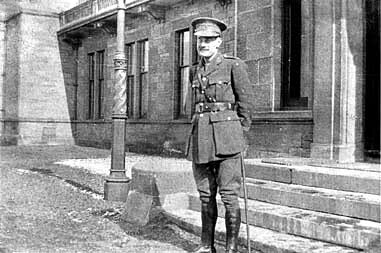 This is an original photograph of the actual Rivers in front of the actual Craiglockhart hospital
Sassoon is introduced
In these chapters, Sassoon arrives at Craiglockhart hospital, where he meets his psychiatrist, Rivers. We learn how he ended up as a patient here: he had written a letter against the war and thrown his medal into the river, and so the government had to do something about him. A friend of his, Robert Graves, persuaded them to admit him into a psychiatric hospital rather than imprison him - although the book makes it clear that he is perfectly sane.
The other inpatients
We see Sassoon's delicate mental state, and learn about his nightmares and hallucinations; and we also encounter some of the other inpatients, including Burns - who vomits whenever he eats, because it reminds him of when a bomb sent him through the air to land, head first, in the exploded intestines of another soldier. Criaglockhart hospital clearly contains lots of living examples of the damage the war has done.
Sassoon's poetry
We also read a few of Sassoon's own poems, which he sends to Rivers as evidence of how he feels and why he has behaved the way he has. This will happen throughout the novel, and Barker allows us to study the character of Sassoon just as much through his poetry as through her own narrative.
Some things to think about:
- Why do you think Sassoon decided to write the letter and throw away his medal?
- What do you think Rivers thinks of Sassoon, and how has this changed since he actually met him?
- What was your response to the other inpatients, especially Burns?
* * * * * * * *
For those of you who want to study the novel in more depth (especially those of you doing your GCSE this year), here are some of the important quotations from these chapters, organised under different thematic headings:
Ghosts and Nightmares
Immediately, he saw lines of men with grey muttering faces clambering up the ladders to face the guns. He blinked them away.
'You can't put people in lunatic asylums just like that. You have to have reasons.'
'They've got reasons.'
'Yes, the Declaration. Well, that doesn't prove me insane.'
'And the hallucinations? The corpses in Piccadilly?'
'It was just that when I woke up, the nightmares didn't always stop. So I used to see...' A deep breath. 'Corpses. Men with half their faces shot off, crawling across the floor.'
'When I woke up, the pavement was covered in corpses. Old ones, new ones, black, green.' His mouth twisted. 'People were treading on their faces.'
Pipes lined the walls, twisting with the turning of the stair, gurgling from time to time like lengths of human intestine.
Nightly, he relived the experience, and from every nightmare he awoke vomiting. Burns on his knees, as Rivers had often seen him, retching up the last ounce of bile, hardly looked like a human being at all. His body seemed to have become merely the skin-and-bone casing for a tormented alimentary canal. His suffering was without purpose or dignity...
Reminiscing about life before the war
He shifted in his seat and sighed, looking out over fields of wheat bending to the wind. He remembered the silvery sound of shaken wheat, the shimmer of light on the stalks.
How Sassoon got his nickname, 'Mad Jack'
'...In the end I didn't know whether I was trying to kill them or just giving them plenty of opportunities to kill me.'
Sassoon's misanthropy and hatred of civilians and people who haven't seen the war first-hand
His voice became a vicious parody of an old man's voice. '"Lost heavily in that last scrap." You don't talk like that if you've watched them die.'
'...The point is you hate civilians, don't you? The "callous", the "complacent", the "unimaginative".'
'You must've been in agony when you did that.'
Sassoon lowered his hand. 'No-o. Agony's lying in a shell-hole with your legs shot off. I was upset.'
Seeing death up close
He remembered...passing the same corpses time after time, until their twisted and blackened shapes began to seem like old friends.
For those of you who want to study the novel in more depth (especially those of you doing your GCSE this year), here are some of the important quotations from these chapters, organised under different thematic headings:
Ghosts and Nightmares
Immediately, he saw lines of men with grey muttering faces clambering up the ladders to face the guns. He blinked them away.
'You can't put people in lunatic asylums just like that. You have to have reasons.'
'They've got reasons.'
'Yes, the Declaration. Well, that doesn't prove me insane.'
'And the hallucinations? The corpses in Piccadilly?'
'It was just that when I woke up, the nightmares didn't always stop. So I used to see...' A deep breath. 'Corpses. Men with half their faces shot off, crawling across the floor.'
'When I woke up, the pavement was covered in corpses. Old ones, new ones, black, green.' His mouth twisted. 'People were treading on their faces.'
Pipes lined the walls, twisting with the turning of the stair, gurgling from time to time like lengths of human intestine.
Nightly, he relived the experience, and from every nightmare he awoke vomiting. Burns on his knees, as Rivers had often seen him, retching up the last ounce of bile, hardly looked like a human being at all. His body seemed to have become merely the skin-and-bone casing for a tormented alimentary canal. His suffering was without purpose or dignity...
Reminiscing about life before the war
He shifted in his seat and sighed, looking out over fields of wheat bending to the wind. He remembered the silvery sound of shaken wheat, the shimmer of light on the stalks.
How Sassoon got his nickname, 'Mad Jack'
'...In the end I didn't know whether I was trying to kill them or just giving them plenty of opportunities to kill me.'
Sassoon's misanthropy and hatred of civilians and people who haven't seen the war first-hand
His voice became a vicious parody of an old man's voice. '"Lost heavily in that last scrap." You don't talk like that if you've watched them die.'
'...The point is you hate civilians, don't you? The "callous", the "complacent", the "unimaginative".'
'You must've been in agony when you did that.'
Sassoon lowered his hand. 'No-o. Agony's lying in a shell-hole with your legs shot off. I was upset.'
Seeing death up close
He remembered...passing the same corpses time after time, until their twisted and blackened shapes began to seem like old friends.
Monday, January 01, 2007
NEW TEXT: Regeneration

This term, we will be reading REGENERATION by Pat Barker. Although this is part of a trilogy of novels about the First World War (The Regeneration Trilogy), we will only be reading the first one as part of the Book Group. Not only is it a pretty extraordinary book, but it will also give invaluable context to your GCSE study of First World War poetry.
A Summary
Regeneration is the fictionalization of Siegfried Sassoon's stay in a mental hospital, Craiglockheart, in 1917 after he'd written a letter to Parliament protesting that the war was being needlessly extended. His psychiatrist, Rivers, is given the task of getting Sassoon to 'see sense and return to the front'. Rivers, a gentle, perceptive, humanitarian, attempts to save Sassoon and the other inmates from the demons that have come to haunt them. His burden is to share their grim experiences as they become able to articulate the horrors that have rendered them psychologically paralysed .
But how do you help people make sense of a world that has possibly gone mad itself? Whilst at Craiglockheart Sassoon meets a young man called Wilfred Owen and gives him valuable advice on his poem 'Anthem For Doomed Youth'. Meanwhile, the reader and Rivers become aquainted with a working class officer, a rarity in itself, named Prior who has lost his ability to speak, through shock or possibly even by choice.
Buying the Book
If you are to take part in the Book Group this term, you will need to get hold of a copy of the book. The quickest among you will get hold of a copy from your local library; the rest of you will need to purchase a copy. Although you can buy it from Waterstones in Walthamstow, this will not be the cheapest way to do so - and you may have to wait to order it from them anyway. The cheapest way to buy a copy is online, by following one of the following links:
N.B. I have purchased 20 copies of the novel, and they will be on sale from me - for £5 each - on a first come first served basis from Friday 5th January.
Reading Schedule
I will expect you to read approximately 20 pages (or two chapters) each week. This should be MUCH easier than last term, as the prose is much more modern and accessible. I suggest you choose a couple of evenings a week, and read a chapter on each one, every week.
You should read:
by Sunday 14th January: Chapters 1-3
by Sunday 21st January: Chapters 4-5
by Sunday 28th January: Chapters 6-7
by Sunday 4th February: Chapters 8-9
by Sunday 11th February: Chapters 10-11
HALF TERM: Catch-up
by Sunday 25th February: Chapters 12-13
by Sunday 4th March: Chapter 14
by Sunday 11th March: Chapters 15-16
by Sunday 18th March: Chapters 17-18
by Sunday 25th March: Chapters 19-21
by Sunday 1st April: Chapters 22-23
Any questions on any of this, just email me...
Mr Savage
Subscribe to:
Comments (Atom)


